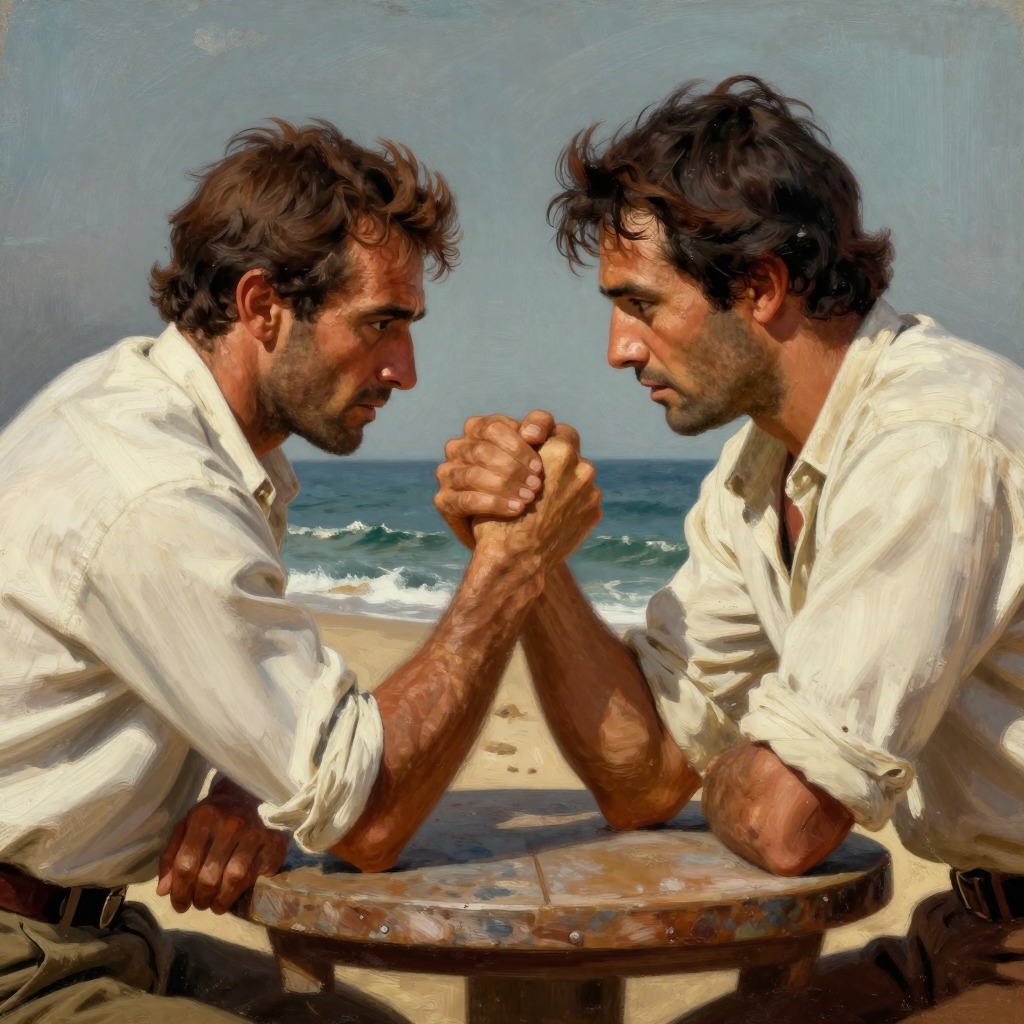
The Hand Game with the Negro from Cienfuegos
The Hand Game with the Negro from Cienfuegos is a flashback event that Santiago, the old fisherman, recalls during his solitary battle with the great marlin, using the memory of his youthful triumph to fortify his will. The match, which took place in a tavern in Casablanca, was a test of raw strength and endurance that lasted more than a full day and night, and it established Santiago as a champion among the fishermen of Havana. The recollection surfaces at a critical moment in his present ordeal, when he is exhausted and in pain, and he deliberately draws on the memory to reassure himself that he possesses the resolve and physical capacity to prevail against the fish.
The Setting and the Opponent
The match occurred in a tavern in Casablanca, a port city on the northern coast of Cuba. Santiago's opponent was a great negro from Cienfuegos, a man recognized as the strongest on the docks. The contest was a hand game, a form of arm wrestling in which the two men sat with their elbows on a chalk line drawn on the table, their forearms straight up, and their hands gripped tightly. Each man's objective was to force the other's hand down onto the table. The room was lit by kerosene lamps, and the walls were painted bright blue. The bettors, who came and went throughout the night, sat on high chairs against the walls, and the lamps cast their shadows against the blue wood. The negro's shadow was huge and moved on the wall as the breeze moved the lamps. The odds changed back and forth all night, and the bettors fed the negro rum and lighted cigarettes for him.
The Course of the Contest
The match began on a Sunday morning and did not end until the following Monday morning. After the first eight hours, the referees were changed every four hours so that they could sleep. Blood came out from under the fingernails of both men's hands, and they looked each other in the eye and at their hands and forearms. The negro, after drinking rum, would try for a tremendous effort, and once he had Santiago, who was not an old man then but was Santiago El Campeon, nearly three inches off balance. But Santiago raised his hand back to dead even. He became sure then that he had the negro beaten. At daylight, when the bettors were asking that it be called a draw and the referee was shaking his head, Santiago unleashed his effort and forced the hand of the negro down and down until it rested on the wood. Many of the bettors had asked for a draw because they had to go to work on the docks loading sacks of sugar or at the Havana Coal Company, but Santiago finished the match anyway, before anyone had to go to work.
Aftermath and Significance
For a long time after that victory, everyone called Santiago The Champion. There was a return match in the spring, but not much money was bet, and Santiago won it quite easily because he had broken the confidence of the negro from Cienfuegos in the first match. After that, Santiago had a few more matches and then no more. He decided that he could beat anyone if he wanted to badly enough, but he also decided that the hand game was bad for his right hand for fishing. He tried a few practice matches with his left hand, but his left hand had always been a traitor and would not do what he called on it to do, and he did not trust it. During his struggle with the marlin, when his left hand cramps and he feels his strength failing, Santiago recalls this past triumph to bolster his confidence. He thinks of the great DiMaggio, who performs perfectly even with the pain of a bone spur in his heel, and he uses the memory of his own championship to prove to himself that he is a strange old man capable of enduring extraordinary hardship. The hand game thus functions as a touchstone of Santiago's identity, a proof of his will and his capacity to suffer and prevail, which he must now call upon again in his solitary contest with the fish.